Three-Axis Handheld Gimbal
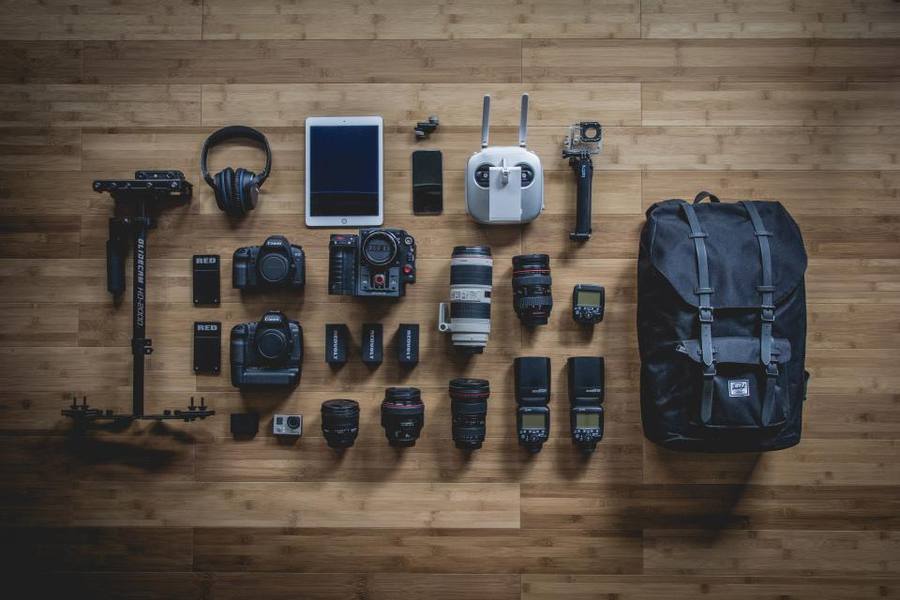
Temsili görsel (stok fotoğraf); ürünün kendisi değildir.
What A Gimbal Does That Stabilisation Cannot
In-body and lens stabilisation correct small vibrations. They cannot correct the large rhythmic movement of walking, which is what makes handheld walking shots look amateurish.
A gimbal uses motors to actively hold the camera level against those movements, producing the smooth gliding motion that reads as professional.
That is a different problem being solved rather than a better version of the same one, which is why cameras with excellent stabilisation still benefit from a gimbal for movement shots.
Balancing Is Most Of The Skill
A gimbal must be physically balanced before the motors are switched on, adjusting the camera position on three axes until it stays put in any orientation with the power off.
An unbalanced gimbal makes the motors work constantly, which drains the battery rapidly, produces visible correction jitter, and can damage the motors over time.
This takes five or ten minutes and must be redone whenever you change lens, add a filter, or alter the camera configuration. Skipping it is the single commonest reason gimbal footage looks poor.
Weight And Endurance
A gimbal plus camera plus lens is heavy, and holding it out in front of you at chest height is tiring within a few minutes rather than an hour.
That physical limit shapes how gimbals are actually used — short deliberate moving shots rather than sustained handheld operation.
Support systems exist, from simple wrist straps to full body rigs, and anybody planning long gimbal days needs one rather than discovering the problem partway through a shoot.
Payload And Lens Choice
Stated payload capacity should be treated as an upper limit rather than a target, since a gimbal working at its maximum balances poorly and responds sluggishly.
Long heavy lenses are particularly difficult because their weight is distributed far from the centre, which a gimbal handles much worse than a compact lens of the same mass.
Zoom lenses that extend when zoomed change the balance mid-shot, which is why internal-zoom or prime lenses are strongly preferred on a gimbal.
Modes And When To Use Them
Follow mode lets the camera pan with the handle while staying level; lock mode holds the direction fixed regardless of handle movement; POV mode allows full tilt with the handle.
Most footage is shot in follow mode, and lock mode is the one that produces the most striking results — walking sideways while the camera stays fixed on a subject.
Learning two modes well produces better footage than knowing all of them shallowly, and the difference between footage that works and footage that does not is usually movement planning rather than mode selection.
Walking technique also matters more than the gimbal specification. The motors correct rotation but not vertical bounce, so walking normally still produces a visible up and down in the footage. The standard approach is a slight crouch with bent knees, rolling the foot from heel to toe and moving smoothly rather than stepping, which looks ridiculous and produces dramatically better results than the same gimbal used with a normal walk.
The Verdict
The tool that makes moving shots look professional, solving a problem in-body stabilisation cannot address at all.
Balancing takes time and must be redone on every change, the weight limits session length, and extending zoom lenses are genuinely problematic.
Balance it properly every time. Unbalanced gimbal footage looks worse than handheld, and it is the mistake almost everybody makes at first.
Bir bakışta
Artılar
- Corrects walking movement that stabilisation cannot
- Produces the gliding motion that reads as professional
- Multiple modes suit different shot types
- Works with cameras that already have stabilisation
Eksiler
- Must be physically rebalanced after every change
- Heavy and tiring within minutes, not hours
- Extending zoom lenses change balance mid-shot
- Performs poorly near its stated payload limit
Sıkça sorulan sorular
My camera has stabilisation, do I need a gimbal?
For walking shots, yes. In-body stabilisation corrects small vibrations; it cannot correct the large rhythmic movement of walking. They solve different problems, which is why good stabilisation and a gimbal are complementary rather than redundant.
Why does balancing matter so much?
An unbalanced gimbal makes the motors work constantly, draining the battery, producing visible correction jitter and wearing the motors. It is the commonest reason gimbal footage looks poor, and it must be redone after any lens or filter change.
Which lens should I use?
A prime or an internal-zoom lens. A zoom that extends as you zoom changes the balance mid-shot, which the gimbal cannot compensate for. Long heavy lenses are also difficult because their weight sits far from the centre.
Teknik Özellikler
| Type | Three-axis motorised gimbal |
| Solves | Walking movement, not small vibration |
| Balancing | Required before every session and after any change |
| Payload | Treat as upper limit, not target |
| Lens preference | Prime or internal zoom |
| Endurance | Minutes, not hours, unsupported |
| Key modes | Follow, lock, POV |
| Common mistake | Shooting unbalanced |
Özet
Solves walking shake that stabilisation cannot touch. Balance it properly every time — unbalanced footage looks worse than handheld.
Amazon'da Fiyatı Kontrol Et